У нас вы сможете в любое время суток открыть и прочесть произведение «Monday Mourning» без единого платежа. На странице представлена не урезанная, а именно целая версия книги — от первой до последней страницы. Если хотите не только читать, но и слушать — пожалуйста, есть аудиоформат. Для тех, кто предпочитает хранить книги у себя на устройстве, работает скачивание через торрент (доступен файл fb2). А если времени в обрез — выручит краткий пересказ содержания. Направление литературы: Легкое чтение, Детективы, Триллеры. Там же, ниже по странице, вы найдёте развёрнутую аннотацию, вступление от автора (если оно есть) и настоящие отклики читателей. Наша электронная библиотека живёт и развивается: мы регулярно добавляем новые издания и делаем навигацию удобнее. Всё это превращает наш книжный портал в настоящий дом для тех, кто не представляет жизни без литературы.
Онлайн книга Monday Mourning
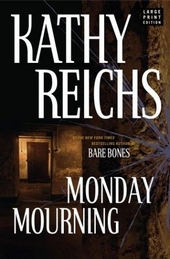
О книге Monday Mourning
Не торопитесь сразу погружаться в полный текст «Monday Mourning». Сначала полезно заглянуть в предисловие, аннотацию, описание или хотя бы бегло пролистать краткое содержание. Авторское предисловие представлено здесь именно так, как его задумал сам писатель (Кэти Райх). Какой-то информации пока нет на странице? Не проблема — оставьте сообщение в комментариях, и мы постараемся разыскать нужные данные специально для вас. Кстати, другие читатели уже делятся своими впечатлениями и мыслями о книге — их отзывы помогут вам взглянуть на произведение под новым углом. И вас самих ждут внизу страницы: поделитесь своим мнением, расскажите, какое послевкусие оставила книга.
Кэти Райх
Читать полностью Monday Mourning
Текст произведения «Monday Mourning» удобно распределён по отдельным страницам — так читать гораздо легче. Система автоматически запоминает, где вы остановились, поэтому возвращаться к потерянному абзацу больше не придётся. И всё это совершенно бесплатно. Кроме того, вы вольны сами настроить размер букв и цвет фона — подберите параметры, которые не будут утомлять глаза. Устраивайтесь поудобнее и погружайтесь в любимые истории где угодно: дома на диване, в транспорте или на природе.
Текст книги
From 1950 to 1963, the values rose to about 85 percent above contemporary reference levels. In 1963, an international agreement halted atmospheric nuclear testing by most nations, and biospheric radiocarbon levels began settling into a new equilibrium.”
“Such folly.” LaManche wagged his head sadly.
“These permutations are known as the fossil fuel and atomic bomb effects.”
LaManche stole a glance at his watch.
“The bottom line is that artificial or ‘bomb’ Carbon 14 can be used to determine if someone died before or after the period of atmospheric nuclear testing.
“How is this test done?”
“There are actually two methods. With the standard radiometric technique, materials are analyzed by synthesizing the sample carbon to benzene, then measuring the Carbon 14 content in a scintillation spectrometer.”
“And the other method?”
“With the other method results are derived from reduction of the sample carbon to graphite. The graphite is then tested for Carbon 14 content in an accelerator mass spectrometer.
For several seconds LaManche said nothing. Then, “How much bone is required?”
“For conventional decay counting, two hundred fifty grams. For accelerator mass spectrometry, just a gram or even less.”
“AMS testing costs more?”
“Yes.”
“How much?”
I told him.
LaManche removed his glasses and squeezed the bridge of his nose with a thumb and forefinger.
“Is there no intermediate step to determine that such an expenditure is justified?”
“There’s one thing I could try. The technique isn’t terribly reliable, but it’s simple and might show if death occurred more or less than a hundred years ago.
LaManche started to speak.
“And free,” I added. “I can do it myself. But again, it will yield only a very rough indication of whether the bones are more or less than a century old.”
“Please.” LaManche repositioned his glasses and rose. “In the meantime I will discuss your proposal with Dr. Authier.”
Jean-François Authier, the chief coroner, considered all requests for exceptional expenditures.
Grabbing a lab coat from my office, I headed to the morgue. Morin and Ayers were already cutting Y incisions in room two. I requested a UV light, and waited while the tech got it. Then I hurried to the appropriate bay and pulled the left femora from skeletons 38426, 38427, and 38428.
In autopsy room four, I wrote the respective case numbers on the proximal and distal ends of the leg bones, and placed them on the autopsy table.
Мнения
Похожие книги